 Online Booking
U.S. Surety Company Avalon Suspends Single Transaction Bonds
Introduction:
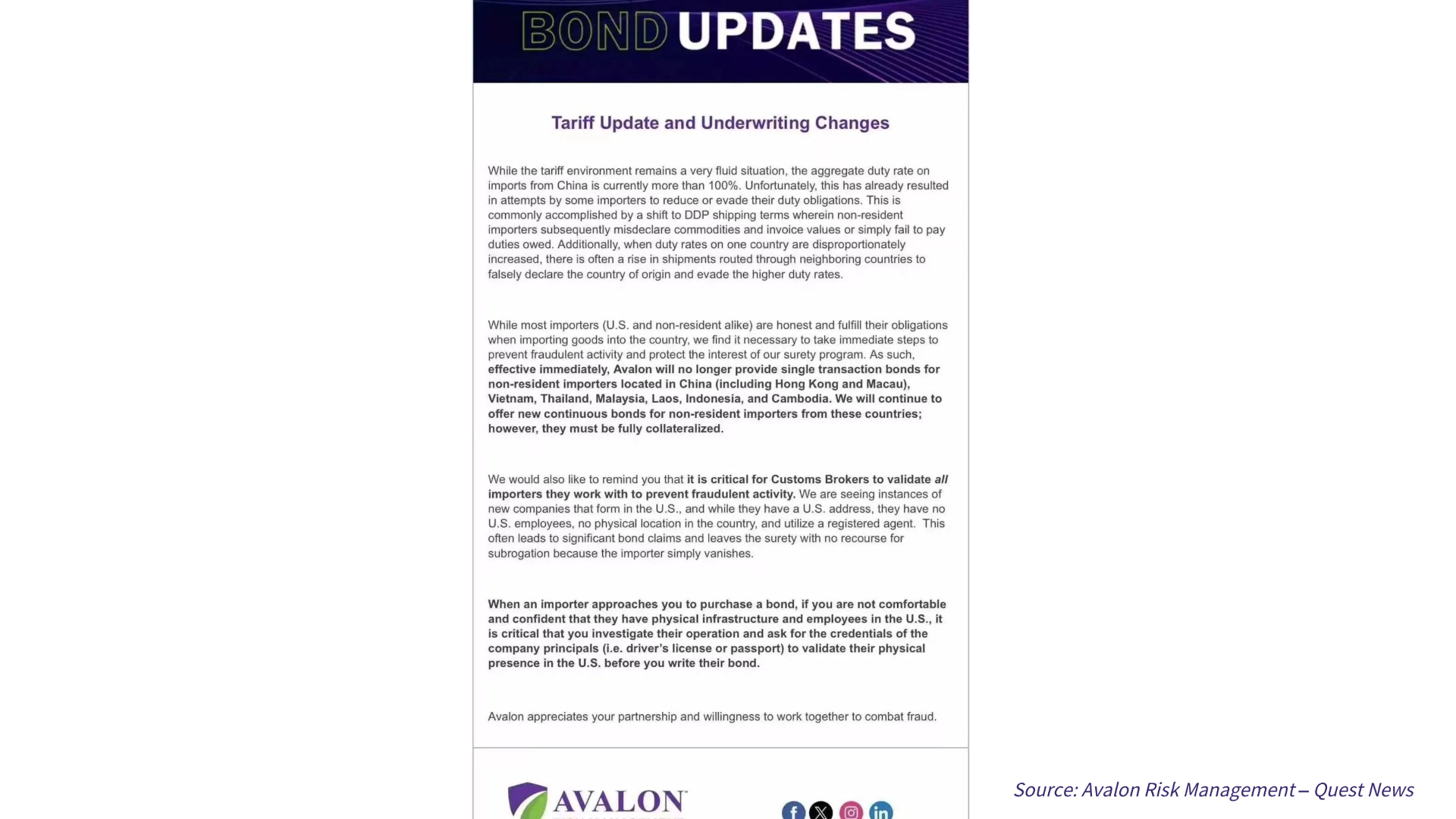
Avalon, a U.S. surety provider, has suspended the issuance of Single Transaction Bonds (STB) for non-resident importers (NRI) from China and several Southeast Asian countries. This policy change is expected to directly impact clearance structures where the importer of record is a non-U.S. entity, particularly DDP and certain turnkey clearance arrangements. The market generally expects U.S. import compliance requirements and importer-of-record reviews to continue tightening.
Key Takeaways
· Avalon has suspended Single Transaction Bonds for certain Non-Resident Importers
· Continuous Bond underwriting requirements have become more stringent
· NRI clearance structures may need to be adjusted
· Compliance costs for DDP and turnkey clearance models may increase
· S. Customs review is increasingly focused on importer legitimacy and duty liability
1. Background
Under the current tariff environment, certain imported products are subject to relatively high duty exposure. If an importer fails to fulfill duty obligations or abandons cargo, the surety company may be required to compensate U.S. Customs and Border Protection (CBP), resulting in increased financial risk for the surety provider.
In this context, surety companies have begun strengthening their review of importer qualifications, financial standing, and recoverability in the event of claims, leading to tighter underwriting policies.
This development indicates that U.S. import compliance is gradually shifting from a process-driven model to one that places greater emphasis on importer legitimacy, financial responsibility, and trade compliance structure.
2. Bond Policy Changes
2.1 Single Transaction Bond Policy Tightening
Avalon has stopped issuing Single Transaction Bonds for non-resident importers located in:
· China (including Hong Kong and Macau)
· Vietnam, Thailand, Malaysia
· Laos, Indonesia, Cambodia
Single Transaction Bonds have traditionally been used for one-time import entries due to their flexibility and relatively low cost. With this policy change, clearance structures relying on STBs may need to be re-evaluated.
2.2 Stricter Underwriting for Continuous Bonds
Non-resident importers may still apply for Continuous Bonds; however, underwriting requirements have become more stringent. These may include:
· Cash or asset collateral
· Financial and credit documentation
· Enhanced Know-Your-Customer (KYC) review
· Verification of actual business operations in the United States
As a result, both financial commitment and compliance requirements for importers are expected to increase.
3. Industry Impact
|
Business Area |
Impact |
|
NRI clearance |
Limited access to Single Transaction Bonds; clearance structures may need adjustment |
|
DDP shipping |
Higher requirements for importer qualification and duty responsibility |
|
Turnkey / tax-included models |
Reduced flexibility under low-cost clearance structures |
|
Transshipment via Southeast Asia |
Increased scrutiny on origin and trade structure |
|
Small and medium importers |
Higher financial and compliance barriers |
Although the policy change occurs at the surety level, the impact extends to the broader U.S. import clearance and cross-border logistics structure.
Overall, U.S. import clearance is shifting from an “operation-focused” model to a “compliance-focused” model, where importer qualification, duty liability, and trade documentation consistency are becoming increasingly important.
4. Recommended Adjustments to Import Structure
Under the current environment, companies should review their U.S. import and clearance arrangements from a structural perspective:
1. Use a U.S.-based importer of record whenever possible
2. Clearly define importer responsibility and bond structure under DDP terms
3. Re-evaluate clearance models that rely on Single Transaction Bonds
4. Strengthen documentation accuracy and trade compliance consistency
5. Consider combining formal import structures with overseas warehousing and domestic distribution
Adjusting the import structure in advance can help reduce uncertainty and improve long-term supply chain stability.
5. TPL Perspective
Recent policy changes suggest that U.S. import oversight is expanding from the customs declaration process to a broader review of importer legitimacy, duty responsibility, and overall trade structure. Clearance stability will increasingly depend on the compliance strength and operational substance of the importer of record, rather than solely on logistics execution.
For companies with long-term plans in the U.S. market, reviewing importer structure, bond arrangements, and clearance models in advance can help reduce regulatory uncertainty and improve supply chain stability.
TPL will continue to monitor U.S. import policy and customs clearance developments and support clients in evaluating more stable and compliant logistics and clearance solutions based on their business models.