 Online Booking
Interpretation of the U.S. Customs Fast Doc Review (FDR) Audit Mechanism
 Background
Recently, U.S. Customs and Border Protection (CBP) has strengthened its document review and risk screening procedures prior to cargo release. The process is commonly referred to in the industry as Fast Doc Review (FDR).
This mechanism is not a new regulation. Rather, it operates within CBP’s existing ACE filing system and the Automated Targeting System (ATS) risk assessment framework. Import entries identified as high-risk or containing abnormal data may be subject to additional manual review and document verification.
As enforcement standards continue to tighten, particular attention is being placed on importer identity verification, declared value accuracy, trade chain authenticity, and Customs Bond compliance.
What Is Fast Doc Review?
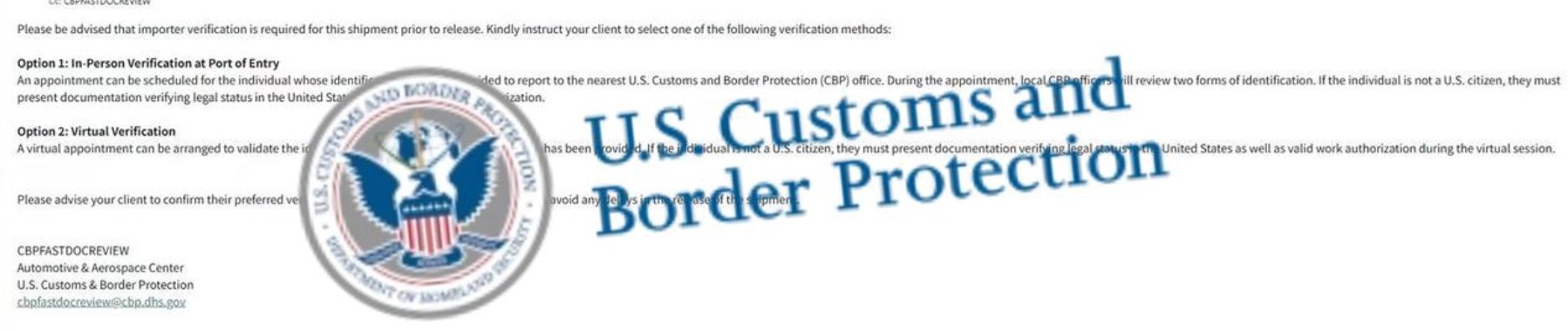
Fast Doc Review is a specialized document verification procedure triggered by the ATS risk-scoring system during the pre-release screening process through ACE.
When the system identifies anomalies or risk indicators, the relevant entry may be flagged for manual review by port trade officers. The review typically focuses on:
- Authenticity and verifiability of importer information
- Reasonableness of declared value based on commercial standards
- Consistency between commercial invoice, packing list, and filed entry data
- Alignment between product description and HTS classification
- Validity and compliance status of the Customs Bond
In certain cases, the importer of record may be required to complete identity verification, either at a designated Port Office or via an online verification process.
Until the review is completed, the cargo release will remain on hold.
Common Triggers
Fast Doc Review is generally triggered by the ATS risk assessment system after identifying irregularities in the submitted data. Based on industry practice, common triggering factors include:
- Abnormal declared value: Unit price or total value significantly deviates from historical import ranges or prevailing market levels
- Inconsistent documentation: Discrepancies in quantity, amount, or product description between invoice, packing list, order data, and customs declaration
- Importer risk profile concerns: Unverifiable importer information, unusually high import frequency within a short period, or prior compliance issues
- Commodity risk factors: Certain high-duty, sensitive, or historically high-inspection product categories
Once such indicators are identified, the entry may be routed into the Fast Doc Review process.
Potential Operational Impact
If an entry enters the Fast Doc Review process, customs clearance timelines may be affected. Depending on the duration of the review, potential operational impacts may include:
- Extended cargo release time
- Increased demurrage charges
- Increased container detention fees
As these costs are typically calculated on a daily basis, incomplete or inconsistent documentation may lead to higher overall logistics expenses.
Importer Bond Considerations
U.S. customs clearance is conducted under the Importer of Record (IOR). All shipments under the same importer are generally linked to the same Customs Bond.
If one entry is identified as non-compliant, CBP may apply heightened scrutiny to other shipments associated with the same bond account. Therefore:
- Importer information must remain accurate and verifiable
- Bond status should be reviewed regularly to ensure validity
- Risk allocation strategies may be considered for different business segments
Proper bond management and importer due diligence are essential in mitigating systemic compliance risks.
Compliance Recommendations and Our Support
In the current tightening regulatory environment, companies are advised to strengthen pre-shipment compliance management, including:
- Ensuring Power of Attorney (POA) is issued from the importer’s official email
- Maintaining accurate and verifiable importer address and contact information
- Declaring values within reasonable commercial ranges
- Ensuring consistency and completeness of all documentation
- Aligning product descriptions accurately with HTS classifications
For cross-border e-commerce shipments, it is particularly important to ensure logical consistency between platform order data and customs declaration information.
To support smooth import operations into the United States, our company has enhanced internal document review procedures and pre-filing risk assessments. This includes declared value review, HTS classification checks, importer verification guidance, and coordination with licensed U.S. customs brokers.
We will continue to monitor CBP enforcement developments and assist our clients in maintaining compliant, stable, and efficient supply chain operations.
In an environment of increasingly stringent regulatory oversight, compliance capability has become a core competitive advantage.
For further information regarding U.S. import compliance requirements or shipment planning, please feel free to contact our team.