 Online Booking
U.S. CBP Tightens IOR Verification: Inaccurate Information May Lead to Immediate Voiding
U.S. import compliance requirements are tightening again.
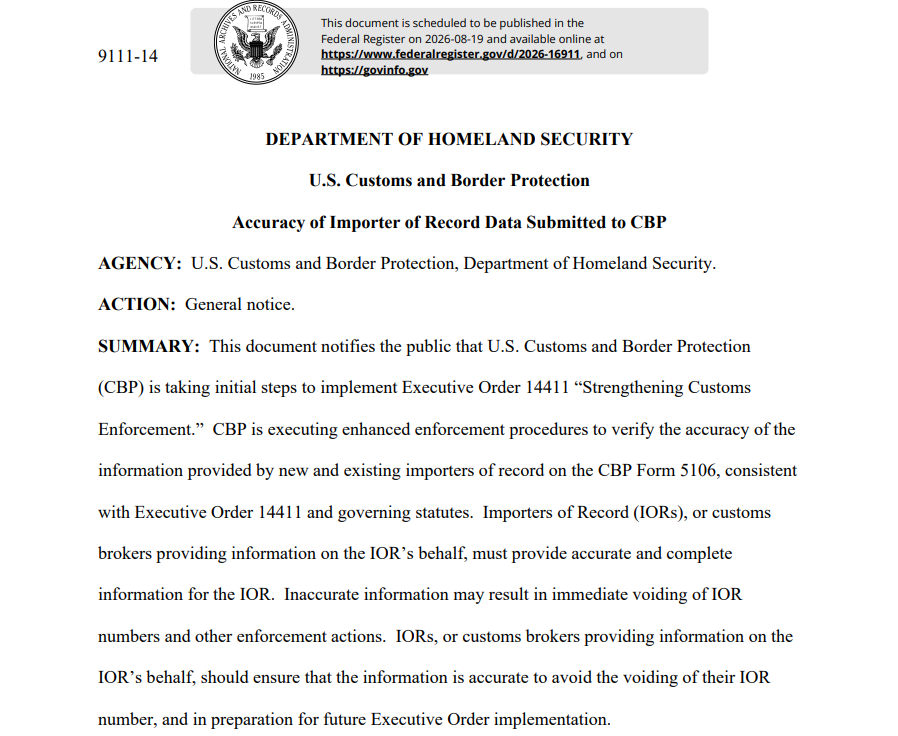
U.S. Customs and Border Protection (CBP) has announced that, beginning September 18, 2026, it will strengthen verification of Importer of Record (IOR) information.
The enforcement action focuses on information submitted through CBP Form 5106. Both newly registered and existing IORs are subject to review. If the information on file is found to be incomplete or inaccurate, CBP may immediately void the IOR number, preventing it from being used for future U.S. import entries.
The measure is also part of the implementation of Executive Order 14411, “Strengthening Customs Enforcement,” issued in June 2026, reflecting a broader shift in U.S. customs enforcement toward closer scrutiny of importer identity and accountability.
1. Scope of Review: Both New and Existing IORs
An Importer of Record plays a central role in the U.S. customs clearance process. Businesses and individuals use CBP Form 5106 to establish or update their importer identity information with CBP.
Starting September 18, CBP will place greater emphasis on whether that information is accurate, complete, and verifiable.
Importantly, the review is not limited to newly created IORs.
Existing IORs are also included. Even an IOR that has been used for years may require attention if historical records contain outdated, incomplete, or inaccurate address, contact, or identity information.
2. Key Verification Areas: IOR Information Must Match the Actual Importer
The new enforcement approach does not introduce a new filing form. Instead, it places greater emphasis on whether the information already submitted accurately reflects the actual Importer of Record.
Businesses should pay particular attention to the following:
|
Information Reviewed |
Key Requirement |
|
Importer / Company Name |
Must match the actual importing entity |
|
EIN and Other Identification Details |
Must be accurate, complete, and consistent with the importer |
|
Physical Address |
Must have a genuine connection to the IOR |
|
Email Address |
Must be a valid contact belonging to the IOR |
|
Telephone Number |
Must allow direct contact with the IOR |
|
Power of Attorney (POA) |
Customs broker authorization should be established directly with the IOR |
CBP has placed particular emphasis on physical addresses and contact information.
The physical address listed for an IOR should not be an unrelated freight forwarder address, customs broker address, registered agent address, P.O. Box, business service center, or another third-party address that has no genuine connection to the importer.
The same principle applies to email addresses and telephone numbers. Freight forwarders, brokers, or other third parties should not substitute their own contact details for those of the actual IOR.
Where a customs broker submits Form 5106 on behalf of an importer, the Power of Attorney (POA) should also be established directly between the broker and the IOR rather than through an intermediary.
3. Compliance Impact: A Voided IOR Can Disrupt U.S. Import Entries
From September 18, if CBP determines that Form 5106 information is incomplete or inaccurate, it may immediately void the associated IOR number.
Once voided, the number can no longer be used for U.S. import entries.
If cargo has already departed or is approaching the United States, an invalid IOR may lead to customs clearance delays and additional costs, including storage, demurrage, detention, or other destination charges.
Cases involving knowingly false, fraudulent, or misleading information may also result in further customs enforcement or legal consequences.
However, a voided IOR does not necessarily mean the importer permanently loses its ability to import.
CBP may issue written notice to the most recent email address on file, explaining why the IOR was voided and what supporting documentation is required to request reestablishment. The IOR or a customs broker holding a valid POA may then submit the required information for review.
For importers, the key point is straightforward:
IOR issues are far easier to address before cargo is in transit than after the shipment has already arrived in the United States.
4. Recommended Actions: Review IOR Information Before September 18
Companies with upcoming U.S. shipments should review their importer information before the new enforcement measures take effect.
(1) Review Form 5106 information
Confirm that the importer name, EIN, physical address, email address, telephone number, and other identifying information are accurate, complete, and up to date.
(2) Verify addresses and contact details
If historical filings use the address, email, or telephone number of a freight forwarder, customs broker, registered agent, or another third party, confirm whether the information meets current CBP requirements.
(3) Confirm customs broker authorization
Importers working with U.S. customs brokers should ensure that the POA relationship is properly established directly between the broker and the IOR.
(4) Confirm IOR status before shipment
For cargo scheduled to move to the United States, importer identity, customs documentation, and IOR status should be checked before booking and departure whenever possible.
The direction of U.S. customs enforcement is becoming increasingly clear: CBP is not only looking at what is being imported, but also at who is importing it.
Executive Order 14411 also calls for further development of IOR eligibility requirements, “good standing” standards, risk classification, and ongoing verification. Importer identity and long-term compliance are therefore likely to play an increasingly important role in U.S. customs clearance.
TPL Recommendation
For companies serving the U.S. market, IOR compliance, customs documentation, and transportation planning should not be treated as separate issues.
As U.S. import enforcement becomes more stringent, confirming the importer structure and customs clearance conditions before shipment is far more effective than trying to resolve problems after cargo arrives.
With more than a decade of experience in U.S.-bound logistics, TPL specializes in ocean freight, LCL, DDU/DDP, and related supply chain services from Asia to the United States. Our team has extensive experience coordinating U.S. import procedures, customs clearance, and transportation arrangements.
In light of the latest IOR verification requirements, TPL can help customers review shipment and importer information, coordinate with professional customs clearance resources, and identify potential risks before cargo moves.
If you have upcoming U.S. imports, ocean freight, or customs clearance requirements, contact the TPL team for professional support.