 Online Booking
U.S. Antidumping Review Update on Chinese Wooden Furniture: AD Rates Up to 251.64%

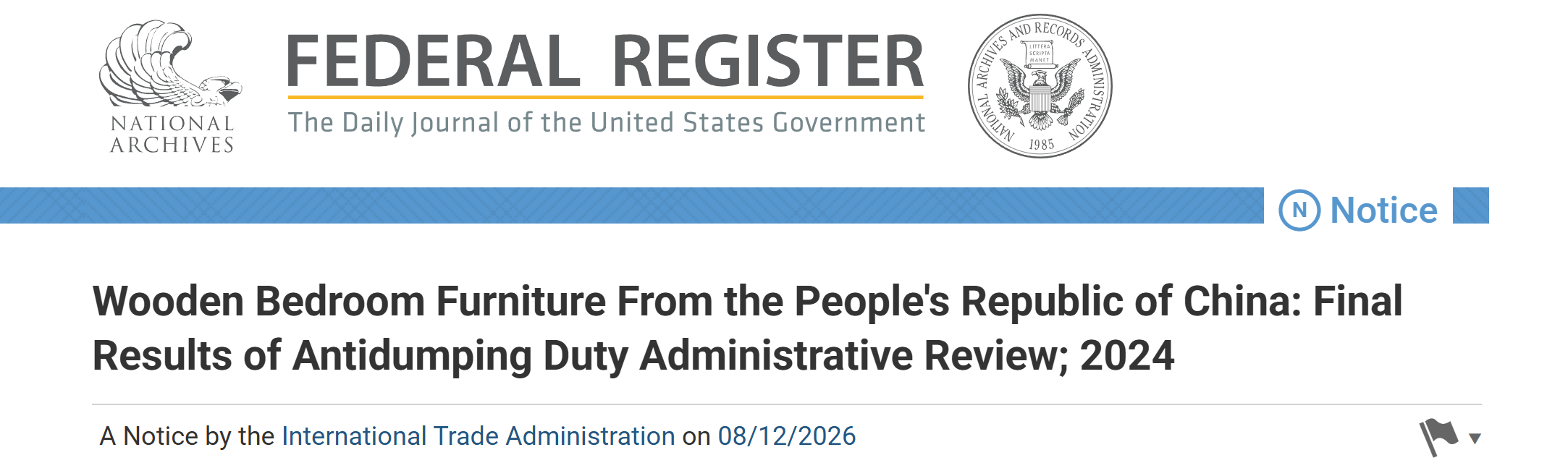
In August 2026, the U.S. Department of Commerce finalized its 2024 antidumping review of wooden bedroom furniture from China. Eleven companies were treated as part of the China-wide entity, with an AD cash deposit rate of 216.01%.
Chinese wooden cabinets and vanities remain subject to a 251.64% China-wide AD rate, with potential additional exposure to CVD, Section 301, and Section 232 duties. Actual duty liability depends on product scope, producer/exporter identity, separate-rate status, and other applicable trade measures.
1. Latest Review Results
Wooden Bedroom Furniture
The latest administrative review covers the period from January 1 through December 31, 2024.
Commerce determined that 11 companies failed to establish eligibility for a separate rate and therefore remain part of the China-wide entity.
The applicable rate for Chinese exporters without a separate rate is:
AD Cash Deposit Rate: 216.01%
The rate applies to relevant entries from August 12, 2026, the date the final results were published in the Federal Register, and remains in effect until further notice from Commerce.
The 216.01% rate represents the antidumping duty only and should not be treated as the total U.S. import duty burden.
Wooden Cabinets and Vanities
For wooden cabinets and vanities, the currently effective final results of the 2023–2024 AD administrative review continue to apply:
China-wide Entity AD Rate: 251.64%
The 251.64% rate is not a new tariff introduced in August 2026. It was already in effect following Commerce's April 2026 final results.
A new 2024–2025 AD administrative review published in July 2026 remains at the preliminary-results stage, with the China-wide entity rate preliminarily maintained at 251.64%. Final results have not yet been issued.
2. Duty Exposure by Product Category
Wooden bedroom furniture and wooden cabinets or vanities may face significantly different U.S. duty structures.
Wooden Bedroom Furniture
For a typical Chinese-origin wooden bedroom furniture product with a 0% MFN base duty that is also subject to the 25% Section 301 tariff and the 216.01% China-wide AD rate, a simplified risk model would be:
0% MFN + 25% Section 301 + 216.01% AD = 241.01%
For goods with a customs value of USD 100,000, the proportional duties under these assumptions would be approximately:
USD 241,010
Actual treatment must still be confirmed based on the specific HTSUS classification and applicable Chapter 99 provisions.
Wooden Cabinets and Vanities
Wooden cabinets and vanities can face a more complex combination of trade measures, including:
· Section 301: 25%
· ection 232: 25%
· AD: 251.64% for the China-wide entity
· CVD: based on the applicable producer/exporter rate
Where the 18.17% CVD All-Others rate applies, a high-risk model could be:
0% MFN + 25% Section 301 + 25% Section 232 + 251.64% AD + 18.17% CVD = 319.81%
For goods with a customs value of USD 100,000, proportional duties under this model could reach approximately:
USD 319,810
The 319.81% figure is not a uniform duty rate for all Chinese wooden cabinets and vanities. AD and CVD must be reviewed separately, and Section 301, Section 232, MFN treatment, and company-specific CVD rates must be confirmed for the actual product and transaction.
As of August 2026, the temporary 10% Section 122 import surcharge that was scheduled to expire on July 24, 2026 should not simply be added to current long-term duty calculations.
3. Determining AD/CVD Scope
Written Scope Takes Priority Over HS Code
Whether a wooden furniture product is covered by an AD or CVD order cannot be determined solely by its HS code, HTSUS classification, or commercial description.
The key legal reference is the Written Scope of the relevant Commerce order.
Product function, construction, material, assembly status, and component form may all affect whether a shipment falls within the scope.
Components and Third-Country Processing
For kitchen cabinets and bathroom vanities, scope coverage may also extend to cabinet doors, drawers, cabinet boxes, components, and certain RTA or flat-pack products.
Moving part of the manufacturing or assembly process to a third country does not automatically remove a product from an existing AD/CVD order.
Products involving Chinese components or third-country processing should therefore be reviewed carefully before shipment.
4. Key Checks Before Shipment
Before shipping affected wooden furniture to the United States, exporters and importers should verify:
1. Whether the product falls within the applicable AD/CVD Written Scope
2. The identity of the actual producer and exporter
3. Whether the exporter has a valid Separate Rate
4. The applicable AD/CVD case numbers and current cash deposit rates
5. Whether Section 301, Section 232, or other Chapter 99 duties apply
Why Separate-Rate Status Matters
Producer and exporter identity can have a significant impact on AD exposure.
For wooden cabinets and vanities, the current China-wide entity rate is 251.64%, while exporters that qualify for separate rates may be subject to substantially lower AD rates.
If a company changes factories, exporters, or supply-chain structures, historical duty rates should not automatically be carried over to the new transaction.
5. Cash Deposits and Final Liquidation
U.S. AD/CVD enforcement operates under a retrospective assessment system.
At entry, CBP generally collects an Estimated Cash Deposit. This does not necessarily represent the final antidumping or countervailing duty liability for the shipment.
After an administrative review, Commerce may determine a different assessment rate and instruct U.S. Customs and Border Protection to liquidate the relevant entries.
Final liability may therefore result in:
· Additional duties due
· Refunds of excess deposits
· Other liquidation adjustments
The August 2026 wooden bedroom furniture final results also reiterate importer obligations relating to antidumping duty reimbursement certifications. Failure to comply may create additional assessment risk.
TPL Perspective
U.S. import compliance for wooden furniture can no longer be evaluated solely by HS code and base tariff rate.
For wooden bedroom furniture, kitchen cabinets, bathroom vanities, and related components, companies should verify the product scope, producer, exporter, separate-rate status, current AD/CVD cash deposit rates, and applicable Section 301 and Section 232 measures before shipment.
China-wide entity treatment can significantly increase import costs. For products potentially subject to multiple trade measures, confirming scope and applicable duty rates before booking and customs entry can help reduce unexpected costs and clearance risks.
TPL will continue to monitor U.S. tariff, customs, and import compliance developments for China–U.S. shipments.
Based on publicly available U.S. government information. For reference only and not intended as legal, tax, or customs advice. Actual duty treatment should be verified against current requirements and the specific product, producer/exporter, and HTSUS classification.